
MAAS 2.8 – new features
by Eduardo Aguilar Pelaez on 24 June 2020
What’s new?
This new release of MAAS brings three key new benefits:
- Virtual machines with LXD (Beta)
- Tighter, more responsive UX
- External/remote PostgreSQL database
If you know what you want, go to maas.io/install, otherwise let’s dive in and explore these further.
Virtual machines (VMs) with LXD (Beta)
MAAS 2.8 can set up L XD-based VM hosts and virtual machines. This is an additional option to the existing libvirt-based VM hosts/VMs functionality.
LXD VMs are manageable without requiring SSH access to the VM host, unlike libvirt KVMs.
As a system administrator, using LXD VMs for other staff members means that you don’t have to give them SSH access to the bare metal servers meaning better permission control of the estate.
Finally, LXD has a clear API making it easy to deploy and manage.
Tighter, more responsive UX

Machine listings have been improved, some of the most visible changes involve the way that long lists are presented within categories, as shown below.
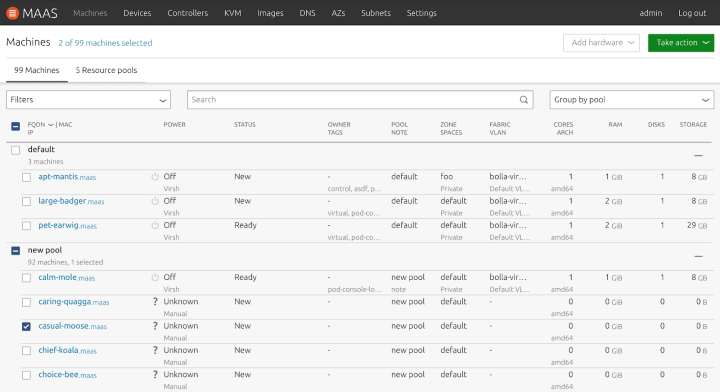
Among those other changes are
- persisting UI state for grouping
- new grouping options
- bookmarkable URLs with filter and search parameters, and many other performance improvements
This was achieved by building the interface from the ground up in React and Redux. If you’re interested in more details, see these blogs on the framework used and speed improvements.
External/remote PostgreSQL database
The MAAS 2.8 snap now has a separate database to allow for scalability. This means that the MAAS database can be located outside the snap either on localhost, or on a remote server altogether.
This will be the approach going forward so we have prepared guides covering set up, management and configuration. If you are testing MAAS we provide a test DB configuration that embeds the database in a separate snap that can easily be connected to MAAS. To learn more please go to maas.io/docs/install-from-a-snap
Other improvements
This release also includes many fixes to ensure a high quality user experience and operations. If you’d like to read more you can read more here.
Related posts
Ubuntu Server: a platform made for enterprise scale
A platform is an environment that allows software to run smoothly across the infrastructure, runtime, and application layers. The key word there is “smoothly”: a good platform connects those layers so well that you don’t notice it. That’s what Ubuntu Server has become: the essential layer between bare metal and the apps running on top, […]
MAAS installation: bare metal provisioning is easier than ever
MAAS brings cloud-like automation to physical servers. It helps teams discover, commission, deploy, and repurpose machines from a central control plane, turning bare metal into a programmable resource. But to experience that value, users first need to get MAAS up and running. That path is now cleaner and easier to follow. We’ve created ne […]
Managing Ubuntu on bare metal at scale
Modern infrastructure teams are expected to deliver cloud-like speed, consistency, and reliability, even when their workloads run on physical servers. Bare metal remains essential for many environments: private clouds, Kubernetes clusters, AI infrastructure, edge sites, regulated platforms, and large Ubuntu estates. But operating physical […]